A Brief Introduction to the Mystic Herb
— 0 —
Walter John de la Mare, an English poet of the late Victorian Era, best known for his distinguished works for the children and for his short fiction stories exhibiting psychological horror, once wrote in his poetry collection Peacock Pie (1913) a poem Mistletoe [1]—
Sitting under the mistletoe
Peacock Pie (1913)
(Pale-green, fairy mistletoe),
One last candle burning low,
All the sleepy dancers gone,
Just one candle burning on,
Shadows lurking everywhere:
Some one came, and kissed me there.
Tired I was; my head would go
Nodding under the mistletoe
(Pale-green, fairy mistletoe),
No footsteps came, no voice, but only, Just as I sat there, sleepy, lonely,
Stooped in the still and shadowy air Lips unseen – and kissed me there.
This short poem, delicately composed in a tender, cosy, sweet tone, resembles a well known practice of the once widely worshipped herb—the mistletoe—that if you happens to be underneath the plant with someone else, you are expected to give them a harmless kiss.
Living in a world where cultural integration and globalisation are no longer rare to be seen, although being raised in the “Far East,” the Western tradition of sharing a kiss under the mistletoe on Christmas Eve is a custom we still hear about occasionally. However, have you ever wondered why mistletoe has such a tradition?
— 1 —
What exactly is mistletoe—so might you wonder. This should therefore serve to be the purpose of the following section, in which I will carefully acquaint you with the mysterious parasitic plant.
Mistletoes are parasitic plants that depend their growth and life cycle upon the nutrition obtained from other flowering plants [2]. Even though many parasitic plants have effective and functional chlorophyll, they nonetheless rely entirely on their plant hosts for all of their other nutritional and water demands as well as for the majority, if not all, of their carbon requirements [2]. They have an advantage over many other kinds of life because they parasitise other higher plants, which eliminates the need for them to compete in the soil for nutrients and water [2].
Mistletoes are a group of parasitic plants that belong to four families, but only two of these—the Viscaceae and Loranthaceae—are commonly known [2]. There are at least nine genera in the broad family Loranthaceae, the majority of which are prevalent in tropical regions [2]. Though the family Viscaceae also includes multiple genera, the mistletoe-related folklore and myths primarily centre around Phoradendron and Viscum, within which Viscum album primarily constituted to the foundation for several mistletoe-related tales, folklore, and religious beliefs on the European continent [2].
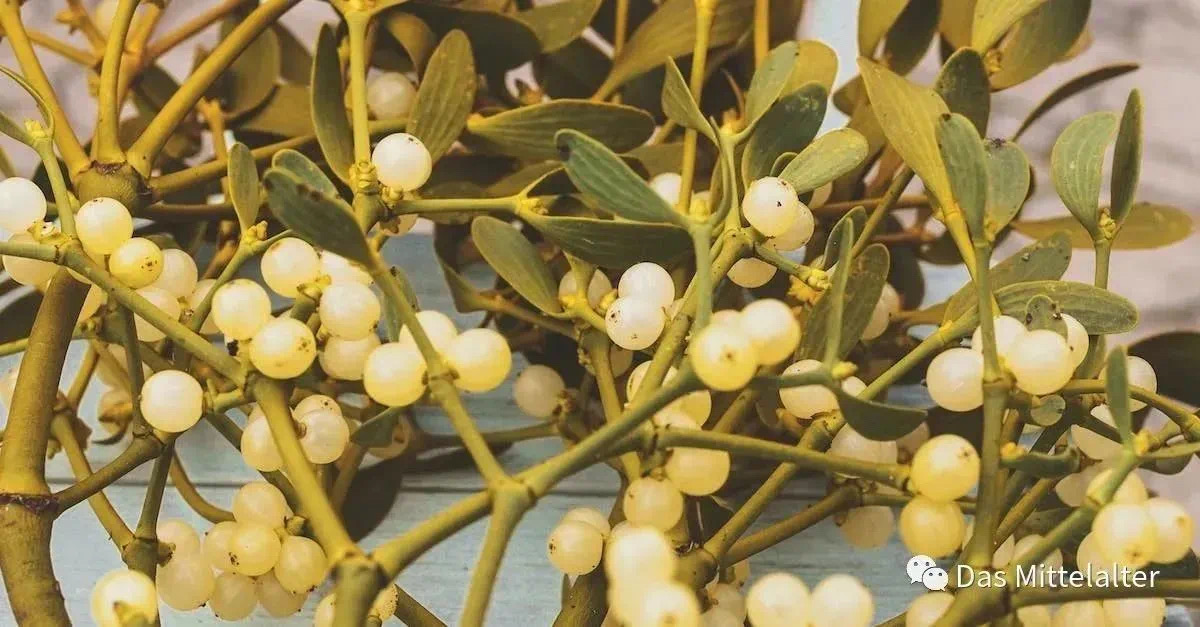
An uniform yellowish-green shade is resembled throughout the entire mistletoe plant, from the root to the tip of the leaf, twig, bough, bark, and everything in between [3]. The only divergence from this pattern is the small lustrous pearls, clustering on the body of the plant—the ripe berries [3]. The combination of the colours is modest and graceful. Albeit the plant’s lack in variety of vivid hues—nor is it known for its glaring ostentation—it is still conspicuous, likely due to the nature of the plant being an evergreen that it stands out in the dead winter as it juxtaposes with the colourless, monotonous branches of the leafless trees through its golden hue, striking the viewer with a strong impression of being both unique and exceptionally pleasing [3].
Among the variety of hosts on which its seed is dropped, the mistletoe likes the best to resort on the oak and the chestnut [3]. Mistletoes are also likely to be found on apple trees, on which, as stated by few, the captious parasite favours the trees with white-fleshed better than those with yellow-fleshed fruits [4].
— 2 —
I have now familiarised you with the fascinating species of the mistletoes. It should not be long before we meet again to introduce a few of the prominent traditions of worshipping the plant in discussion.
References
[1] De, W. (1924). Peacock Pie.
[2] What Does Mistletoe Have To Do With Christmas? (n.d.). What Does Mistletoe Have to Do with Christmas? https://www.apsnet.org/edcenter/apsnetfeatures/Pages/Mistletoe.aspx
[3] F. R. (1875). The Mistletoe. The Aldine, 7(13), 249. https://doi.org/10.2307/20636929
[4] Anon. (n.d.). MISTLETOE. – ProQuest. http://Www.proquest.com. Retrieved November 5, 2023, from https://www.proquest.com/openview/bbd335469ae75da7/1?cbl=2212&pq-origsite=gscholar&parentSessionId=yAFd4088ufbkaCRXNdNWANHCzuNGTVWADEO+VfQfYV4=
 Historia cum Ioanna
Leave a comment