What are some of the practices of worship?
— 0 —
An antique Scottish superstition once records, the Hays of Errol, an estate in Perthshire, lying near the Firth of Tay, had their fate tightly interwoven with the mistletoe that fostered on an enormous oak of an unknown age [1]. This old myth was told by Thomas the Rhymer (1220-1298), a Scottish poet and prophet of great renown, in verses [2]—
While the mistletoe bats on Errol’s aik,
Thomas the Rhymer (1220-1298)
And that aik stands fast,
The Hays shall flourish, and their good grey hawk
Shall nocht flinch before the blast.
But when the root of the aik decays,
And the mistletoe dwines on its withered breast,
The grass shall grow on Errol’s hearthstane,
And the corbie roup in the falcon’s nest.
This piece of poetry has exhibited an important aspect of the mistletoe-related beliefs, that this herb of golden hue can bring us good fortune and good luck. Then what are some other mistletoe-related beliefs? You might wonder so, and this should thus be the focus of this article.
In this article, we shall delve into the topic of mistletoe worship and discover a few scraps of the worshipping practices of this particular plant which is perceived to be sacred long since.
— 1 —
The functions traditionally ascribed to the mistletoe species can be categorised into the following five genres: protection from witchcraft and evil (can also be further extended to the concept of attracting good luck), obtaining fortune and wealth, connection with fire, divination and prophecy, and medicinal and healing power.
- Protection from Witchcraft and Evil
The first prominent property commonly attributed to the mistletoe is its power against witchcraft and the evil. For instance, the superstition of the Hays of Errol mentioned above is a typical example of such property, only in an extended form of believing the plant also brings good luck. Moreover, it was said that a Hay used to cut a sprig of mistletoe on Halloween with a new dirk, and surrounded the oak tree three times in the direction of the sun before casting a specific spell [1]. This sprig of mistletoe was then believed to be an infallible charm against all witchcraft and an invincible arm in battles and fights [1]. Similarly, in Germany, the parasite is widely recognised as a safeguard against witchery; in Sweden, a branch of mistletoe collected on the Midsummer’s Eve shall be fastened to the ceiling of different structures, including one’s house and the horse’s stall, to deprive the approaching trolls of their power to harm man and the livestock [1]. The peasants of Britain, like their Swedish counterparts, hung a large bundle of mistletoe before their dwellings to ward off evil and protect the farm animals [1].
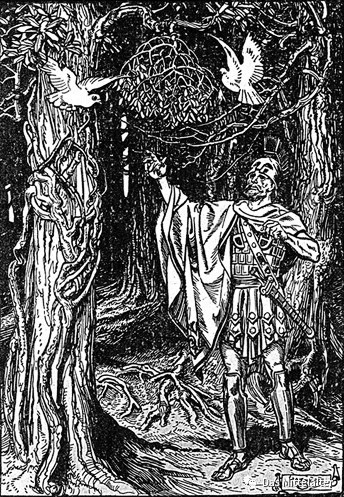
The tale of Aeneas, written by Virgil, also resembled the protecting power of the Golden Bough, which has long been interpreted as mistletoe but seen through the lens of glorification [1]. Virgil has illustrated how equipping Aeneas with the bough of mistletoe was able to make the man fearless in confronting the terrifying ghosts that would come in his way on his daring voyage [1].
- Obtaining Fortune and Wealth
Another significant aspect of the functions ascribed to the plant was its power to obtain its possessor fortune and wealth. Mistletoe is traditionally believed that it possesses the power of disclosing treasures beneath the soil. In Sweden, people craft divining rods out of mistletoe on Midsummer Eve [1]. After sunset, the treasure-seeker sets the rod on the ground [1]. When the rod rests precisely over the sought treasure, it moves as though it were alive as an indication of the fortune underground [1].
A yellow-coloured counterpart of mistletoe is also believed to possess treasure-seeking power. The mythical fern seed, probably due to its similar shade as the mistletoe species, shares the properties ascribed to the mistletoes to a certain extent. It’s said in Russia that if you are successful in capturing a stunning fern bloom at midnight on Midsummer’s Eve, all you have to do is throw it skyward and it will land like a star exactly where a buried treasure is waiting to be discovered [1]. Furthermore, according to a superstition in Bohemia, if you were to put some fern seed amid your money, no matter how much money you spend, the total amount shall never dwindle [1].
- Connection with Fire
Mistletoe is usually collected at Midsummer or at Christmas, i. e. Midwinter, the two solstices of a year, since the plant is considered to be in close correspondence with the sun’s fire [1]. Hence, it is sensible to see why the parasite was believed to be a remarkable apparatus of extinguishing fire [1]. For instance, in Sweden, people keep it in their residences as a fire precaution measure [1].
- Divination and Prophecy
In some places in Britain near Wales, a damsel who aspires to know her future husband with whom she shall wed should mindfully place a white cloth under an oak tree on Midsummer’s eve [1]. On the very next morning, it is said that some dust should be found on that piece of cloth—it is the dust of the fleeting oak-tree blossom—and the damsel should sleep with a pinch of dust underneath her pillow, dreaming about her future husband at night [1].
This oak-tree blossom depicted in the myth is highly likely to be the mistletoe plant, and what is more, a similar practice of inducing premonitory dreams was observed in Wales, only with actual mistletoes being gathered [1]. It is also conjectured by scholars that this practice of prophecy with mistletoe is a fragment of the Celtic Druid rituals, where mistletoe sprigs were also captured with placing a white cloth under oak trees [1].
- Medicinal and Healing Power
As the last feature of mistletoe worship, it is the universal healing power accredited to the mistletoe. Even the meaning of mistletoe in the ancient Druid language was “all-healing [3].” It was regarded as a cure for all by many. Some said it would work as a potion to impregnate infertile animals [3]. If chewed, it is believed to cure ulcers [3]. Even Pliny recognised that it might be useful to enhance pregnancy in addition to being an epilepsy remedy [3].
It is an amusing fact that even until 1900, mistletoe was used as a treatment for epilepsy [3]. Their reasoning being, an epileptic who drank an extract of mistletoe or kept it in their pocket was unable to possibly collapse to the earth since mistletoe is rooted in a tree’s branch and thus cannot possibly drop to the ground [3].
It was also seen in some regions of Italy, peasants searched for the oak trees in the morning hours of Midsummer for the “oil of St. John,” which, like mistletoe, is believed to cure all injuries [1].

— 2 —
We have so far discovered the five major aspects of mistletoe-related beliefs—protection from witchcraft and evil, obtaining fortune and wealth, connection with fire, divination and prophecy, and medicinal and healing power. Nonetheless, the history of mistletoe worship ranged from the far past of the ancient history to the current world. Therefore, it is inadequate to briefly summarise the worshipping activities of the herb in one single article, as the implications shift as time passes.
References
[1] Frazer, J. G. (2015). GOLDEN BOUGH : a study in comparative religion (classic reprint).
[2] Frazer, L. (1924). Leaves from the Golden Bough.
[3] What Does Mistletoe Have To Do With Christmas? (n.d.). What Does Mistletoe Have to Do with Christmas? https://www.apsnet.org/edcenter/apsnetfeatures/Pages/Mistletoe.aspx

 Historia cum Ioanna
Leave a comment